- You are here:
- GT Home
- Sciences
- Home
- List of Available Research Projects
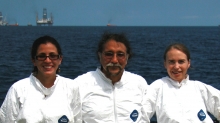
Advection and biological consumption are both important sinks for oil and gas released from natural seeps in the Gulf of Mexico. We will use a combination of stable isotope measurements and high resolution modeling with both passive and positively buoyant tracers to study the interaction between physical and biological processes in distributing and transporting the carbon released from natural seeps. We will focus on three major seep fields in the Northern Gulf with different water depths –GC185 (ca. 400 m), GC600 (ca. 1200 m), and GC767 (ca.
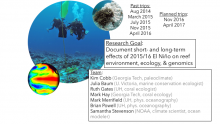
Geochemical time series from remote Pacific atolls have provided long records of climate variability that extend into the pre-industrial era. Recent studies document a wide range of geochemical variability in corals growing on the same reef, ostensibly of the same genus. Deciphering which fraction of coral geochemistry variations are driven by changes in physical environment versus physiological differences between corals is key to constructing more robust records of past climate variability.
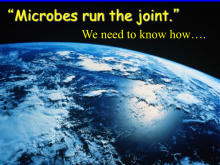
Seaweeds create toxic compounds to deter consumers (fish) and poison competitors (corals). However specific fishes resist these toxins, and some corals also are resistant to their effects. These tolerances may be due to unusual microbes in the gut microbiomes of fishes and in coral mucus coverings. GT has an unusual mixture of marine ecologists, chemists and microbiologists to address these issues.

Many densely populated coastal areas around the world are low lying and susceptible to relative sea level rise (SLR) associated with climate change, land level subsidence or tectonic subsidence. Coastal defense structures have been constructed as barriers to certain design storm surge, storm wave or tsunami heights. Typically even without SLR the design criteria change over time as hazards get reanalyzed or remodeled. The decrease in risk reduction due to relative SLR and the performance of existing defense barriers under loading conditions beyond the design need to be determined.
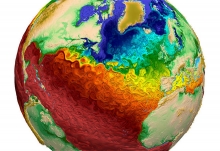
The project aims at further testing a new approach, the maximum entropy production (MEP) model of surface heat fluxes (Wang et al, 2014), for modeling and monitoring air-sea exchange of water and heat air-sea water and heat.
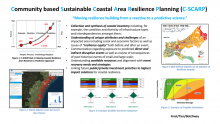
This study seeks to develop a location independent scalable framework for Community based Sustainable Coastal Area Resilience Planning (C-SCARP).
The data-driven framework is adaptable to other locations and/or scales in the future. The proposed C-SCARP framework will make use of an adapted and expanded version of the GoldSET suite of decision support tools that incorporates multi-criteria analysis in a sustainability evaluation framework. Three distinct uses of GoldSET are anticipated:
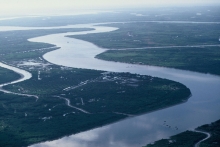
The exponential growth of human populations in the Mekong-South China Sea (SCS) system, the eutrophication of estuarine and coastal waters by excess nutrients transported by the Mekong River, and the rapid sinking of the Mekong Delta are fundamentally changing the biological productivity and biodiversity of the system, with uncertain implications these aquatic resources. In the near future, larger forcings will alter the linkages between the Mekong system and the SCS basin.
The project aims at further testing a new approach, the maximum entropy production (MEP) model of surface heat fluxes (Wang et al, 2014), for modeling and monitoring air-sea exchange of water and heat air-sea water and heat.
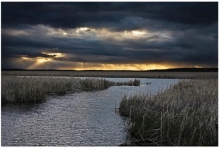
In coastal areas, data are very sparsely available for flow and wave conditions during storm events due, in part, to the logistical challenge of deploying instruments in such conditions. The questions proposed are centered around the strength and consequences of the flow conditions during storm events and the influence of vegetation on mitigating the effects.
The exponential growth of human populations in the Mekong-South China Sea (SCS) system, the eutrophication of estuarine and coastal waters by excess nutrients transported by the Mekong River, and the rapid sinking of the Mekong Delta are fundamentally changing the biological productivity and biodiversity of the system, with uncertain implications these aquatic resources. In the near future, larger forcings will alter the linkages between the Mekong system and the SCS basin.