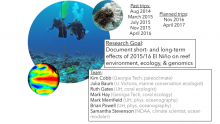
Geochemical time series from remote Pacific atolls have provided long records of climate variability that extend into the pre-industrial era. Recent studies document a wide range of geochemical variability in corals growing on the same reef, ostensibly of the same genus. Deciphering which fraction of coral geochemistry variations are driven by changes in physical environment versus physiological differences between corals is key to constructing more robust records of past climate variability.
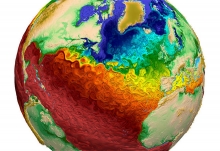
The project aims at further testing a new approach, the maximum entropy production (MEP) model of surface heat fluxes (Wang et al, 2014), for modeling and monitoring air-sea exchange of water and heat air-sea water and heat.

Nonlinear dispersive wave groups or packets occur in a wide range of natural systems, exhibiting complex behaviors especially in focal zones where there is rapid wave energy concentration and possible wave breaking. In the presence of dispersion, pure plane waves of different wavelengths and directions traveling within a medium have different propagation velocities. Important classes of geophysical wave systems include surface gravity waves, oceanic and atmospheric internal waves, and seismic waves.
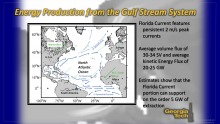
The recently completed resource assessment for ocean current energy (Haas et al. 2013) utilized fairly simplistic analytical methods to estimate the extractable energy from the Gulf Stream System as well as to analyze the relative impacts of large scale energy extraction. This level of analysis can be considered to be accurate to an order of magnitude and only provides an idea on the overall trends of the impacts of extraction. Much higher resolution modeling is required to accurately determine the overall impacts of extraction for both localized and far field effects.

The student will work jointly between the labs of Drs. Frank Stewart (Biological Sciences) and Kostas Konstantinidis (Biological Sciences, Civil and Environmental Engineering) to characterize a globally important marine bacterial group (SAR11). A collaboration between these labs recently described how SAR11, the world’s most abundant organismal group, has adapted to the unique chemical and physical environment of anoxic oxygen minimum zones (OMZs). This work (Tsementzi et al.
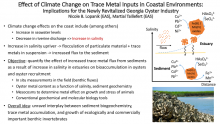
The effects of climate change on the coastal ocean include a decrease in riverine inputs and increase in salinity in estuaries with impacts on primary production, macrofauna, and sediment biogeochemistry that are poorly understood. One clear effect of the increase in salinity associated with the decrease in riverine discharge, however, is the enhanced coagulation of inorganic material further upriver. Flocculation of particulate material upriver will enhance its flux to the sediment and simultaneously decrease the outflux of particulate material to the continental shelf.